Nubia
Death on the NileNubia is the setting into which the travelers pass aboard the Karnak, a region presented through river travel, bare rock, settlements altered by damming, and immense monuments. The landscape is more than a sightseeing backdrop: its visible environmental change and its passengers’ sharply different responses give the journey an atmosphere of beauty, unease, and unresolved tension.
River Journey and Arrival
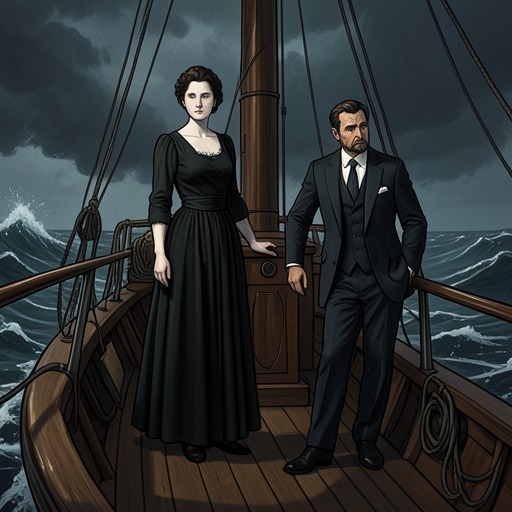
The route carries the party beyond the familiar tourist stops and into Nubia. Wadi Halfa and the Second Cataract arise as points on the journey, and the Karnak later moves through a narrow gorge where rock descends steeply toward the deep, swift river. The narrowing passage makes the change of region feel physical: the passengers are traveling into a landscape that seems to close around the water.
The journey also brings an unexpected change in company. Rosalie Otterbourne is surprised to see Linnet Doyle and Simon Doyle emerge from a cabin aboard the vessel; she had not known they were joining the trip. At first the couple appear radiant and assured, Simon grinning with the ease of a happy schoolboy. Yet, as the Karnak enters the gorge, Simon tells Linnet that they cannot run away forever and must go through with it. Soon afterward, Linnet stands beside Hercule Poirot with restless fingers and an air of bewildered vulnerability. The passage into Nubia thus coincides with a sharp contrast between the couple’s public happiness and the strain visible in private.
Riverside Encounters
At a dusty stretch of road beside the river, the travelers are quickly surrounded by sellers and prospective guides: five bead sellers, two postcard vendors, three sellers of plaster scarabs, donkey boys, and hopeful children. Their offers range from beads and scarabs to a fly whisk, a boat excursion, or a donkey ride back to the hotel. The scene turns the riverbank into a place of immediate commercial negotiation, where the visitors’ progress is repeatedly interrupted by attempts to sell them souvenirs and services.
Hercule Poirot makes vague gestures to free himself from the crowd, while Rosalie moves through it as if sleepwalking. She remarks that the best response is to pretend to be deaf and blind; the children continue alongside, appealing plaintively. The episode makes the tourist encounter concrete: visitors can treat the sellers as part of the bustle to be evaded, while the sellers persist in addressing them as potential customers.
A Changed and Uneasy Landscape
As the vessel travels farther into Nubia, Rosalie welcomes the feeling of getting away from things and people. Before her are water, stretches of rock without vegetation, and traces of houses left abandoned and ruined after the waters were dammed. The scenery carries two impressions at once: a harsh, exposed quality and a melancholy, almost sinister charm. The ruined houses register the lasting alteration of habitation by the damming, even as the travelers take in the view from the river.
Rosalie’s response soon turns from the landscape to her own sense of injustice. She says the country brings buried feelings to the surface and complains of how unfair life is, comparing her mother, Salome Otterbourne, unfavorably with other mothers. Poirot does not dismiss her outburst; he encourages her to let what is boiling inside come to the surface so that it can be dealt with. In this exchange, the region’s remoteness offers Rosalie a setting in which to speak openly, but it does not relieve the personal resentment she carries.
Monuments and the Tourist Gaze
The passengers’ encounters with Nubia’s monuments expose competing ways of valuing the past. During the boat journey, a young passenger condemns the Pyramids as monuments built to gratify a ruler at the cost of the people who labored and suffered. Mrs. Allerton counters that a world without great monuments and beautiful temples would sacrifice something enduring; Poirot observes that human beings do not last as well as stone. The exchange makes sightseeing an argument about whose lives and whose achievements deserve attention, rather than a simple celebration of ancient grandeur.
On Monday morning, with the Karnak moored near the bank, the passengers see a great temple carved into the rock. Four colossal figures look out over the Nile toward the rising sun. Cornelia Robson describes feeling small before the figures, while Simon Doyle admits that the place affects him despite his general lack of interest in temples and sightseeing. The monument’s scale changes the visitors’ sense of themselves, even as the earlier argument has made the human labor behind monumental history difficult to ignore.
Narrative Significance
Nubia repeatedly holds spectacle and disturbance in the same frame. The river gorge and rock-cut temple invite wonder; abandoned houses recall a landscape altered by damming; the crowded riverbank turns travel into a commercial encounter; and Rosalie’s confession gives the remote setting a personal charge. These details prevent the region from functioning only as a succession of scenic attractions.
The journey’s apparent escape from ordinary life also fails to quiet the travelers’ conflicts. Rosalie speaks of wanting distance from people, only to be confronted by the unexpected arrival of the Doyles. Their visible happiness gives way to Simon’s admission that escape cannot continue, while the immense landscape and monuments remain indifferent to their private predicament. Nubia therefore shapes the novel’s atmosphere through contrast: the passengers move among vast, enduring forms, but their anxieties and relationships remain immediate and unsettled.